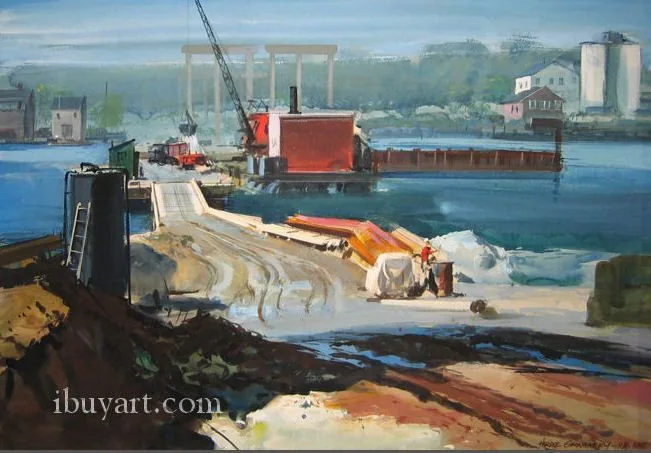
Every painting tells us something, but narrative art sets out to tell a story. It might capture a single moment that makes us wonder what came before and what happens next, or it might lay out a sequence of events. For much of the twentieth century this kind of art was treated as a lesser cousin of “serious” painting, something for magazines and children’s books rather than museums. That view has changed, and today American narrative art is collected, studied and exhibited as an important part of the country’s artistic history.
Storytelling on the page
The modern American tradition of narrative art grew up alongside the illustrated press. In the late nineteenth century, improvements in printing allowed magazines and books to reproduce pictures in large numbers, and a new profession of illustrator took shape. Howard Pyle, who taught in Delaware and Pennsylvania around the turn of the century, is often seen as the founder of this tradition. After 1900 he ran his own school of illustration, and his students included N. C. Wyeth, Frank Schoonover and Jessie Willcox Smith. The scholar Henry C. Pitz later called this circle the Brandywine School, after the river valley where many of them lived and worked.
Pyle taught his students to imagine themselves inside a scene and to paint it as if they had witnessed it. The result was a style of picture-making that was dramatic, carefully composed and easy to read, ideal for adventure stories, history and romance. Wyeth’s illustrations for books such as Treasure Island became classics in their own right.
The best-known heir to this tradition was Norman Rockwell. For nearly five decades his covers for The Saturday Evening Post presented scenes of everyday American life — families at the dinner table, children at the doctor’s office, a soldier coming home. Rockwell’s pictures were narrative in the purest sense: each one told a complete story at a glance, and millions of readers recognized themselves in them.
Stories in paint
Narrative art was never confined to illustration. Genre painting, which depicts scenes of ordinary life, has a long history in American art, and the American Scene and Regionalist painters of the 1920s and 1930s often worked in a storytelling mode. Their pictures of farm families, small-town streets and Depression-era workers invited viewers to read the lives of the people shown. World War II added another chapter, as official war artists and combat artists recorded events in the field. On this site, Ed Reep, Arthur Beaumont, Barse Miller and Standish Backus Jr. all painted the war as it happened.
California and the film studios
In California, narrative art took on a special character because of Hollywood. From the 1930s onward, the film and animation studios employed many of the same artists who exhibited watercolors with the California Water Color Society. Hardie Gramatky, Lee Blair and Charles Payzant all worked for the Walt Disney Studios — Gramatky as an animator, Blair on films such as Pinocchio and Fantasia, and Payzant painting backgrounds for Snow White and other features. Gramatky also wrote and illustrated the children’s classic Little Toot. Emil Kosa Jr. spent decades as a scenic artist at Twentieth Century-Fox while building a reputation as a fine art painter.
This crossover between studio work and fine art shaped California painting. Artists trained to stage a scene for the screen brought the same skills to their watercolors: a strong point of view, clear action and a sense of a moment in time. Many California Scene paintings of harbors, city streets and beaches feel like a frame from a film, with figures going about their business in a setting that tells you exactly where you are.
A growing appreciation
Museums now give narrative art a central place. The Norman Rockwell Museum in Stockbridge, Massachusetts, describes itself as a home for American illustration. The Hilbert Museum of California Art at Chapman University in Orange is dedicated to California narrative art and California Scene painting, and its collection includes works by Millard Sheets, Emil Kosa Jr., Milford Zornes and Rex Brandt, along with Disney art and works by Norman Rockwell. In Los Angeles, the Lucas Museum of Narrative Art, founded by filmmaker George Lucas and Mellody Hobson, opened in September 2026 with a collection that spans painting, illustration, comic art and film.
For collectors, narrative art offers a particular pleasure. These are pictures that reward a second look and invite conversation. A watercolor of a fishing harbor or a street fair is not only a landscape; it is a record of how people lived, worked and spent their leisure time. That sense of story is a large part of why California and American paintings from this period remain so appealing today.
Selling a painting?
I buy original California and American paintings from the late 1800s to the 1990s, including the work of many of the artists named above. Send me a few photos for a free art evaluation.
More reading: all essays · styles I buy.