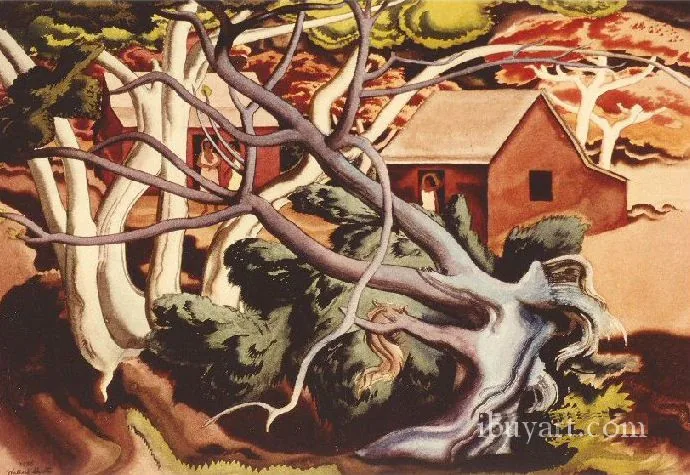
Between the 1920s and the 1960s, a generation of California artists turned their attention to the life around them. They painted farms and orchards, fishing harbors, beach crowds, oil fields, freeways, small towns and the growing city of Los Angeles. The Los Angeles Times critic Arthur Millier is credited with giving this work a name: California Scene painting. Today it is recognized as the state’s most distinctive contribution to the American Scene movement.
From plein air to the everyday
California Scene painting grew out of an earlier tradition. In the first decades of the century, the state’s Impressionist and plein air painters had celebrated its landscape — the coast at Laguna Beach and Carmel, the eucalyptus groves, the mountains and the desert. Organizations such as the California Art Club, founded in Los Angeles in 1909, and the Laguna Beach Art Association, founded in 1918, gave these painters a public and a market.
The next generation shared their love of California’s light but looked in a different direction. Instead of seeking out untouched nature, they painted the places where people lived and worked. Their California was a state of cities and highways, ports and packing houses, as well as hills and beaches. In this they had much in common with the Regionalists of the Midwest, and the movement is sometimes called Southern California Regionalism.
The California Style
Most California Scene paintings were made in watercolor, and the movement is closely tied to what became known as the California Style. In the late 1920s, a group of young painters, many of them students at the Chouinard Art Institute in Los Angeles, began to use watercolor in a new way. Rather than treating it as a medium for small sketches, they painted on full sheets of paper with strong color and broad, vigorous brushwork, often working quickly on location.
Millard Sheets was a central figure. His watercolors were accepted in the California Water Color Society’s annual shows while he was still a teenager. He later taught at Chouinard, Otis and Scripps College, painted murals and served as president of the California Water Color Society in 1946. Around him gathered painters such as Rex Brandt, Phil Paradise, Barse Miller, Milford Zornes, Tom Craig, George Post, Emil Kosa Jr., James Patrick and Phil Dike. The California Water Color Society, whose first president was Dana Bartlett, gave them a place to show their work, and its annual exhibitions spread the style.
Depression, war and the New Deal
The movement came of age during the Great Depression. New Deal programs, including the Public Works of Art Project and the Federal Art Project, employed artists to paint murals and easel pictures for public buildings, and many California Scene painters took part. George Post painted watercolors for the WPA, and Milford Zornes produced work for the Public Works of Art Project. These commissions gave artists a living at a difficult time and encouraged them to paint subjects that ordinary people would recognize.
World War II brought another shift. Several California watercolorists became war artists, including Ed Reep, Barse Miller, Tom Craig and Milford Zornes, and their work carried the California Style to battlefields and bases around the world. Others recorded the home front, from aircraft plants to blackout streets.
After the war
In the post-war years the California Scene painters were widely known. They taught a new generation at Chouinard, Otis, Art Center, Scripps and elsewhere, and painters such as Robert E. Wood, George Gibson and Noel Quinn carried the tradition into the 1960s and beyond. Many also worked for the film and animation studios, which brought a storytelling quality to much of their work.
By the 1960s, abstraction and new movements had pushed realist painting out of fashion. In the decades since, collectors, dealers and museums have returned to California Scene painting with fresh eyes. The Hilbert Museum of California Art at Chapman University, the Laguna Art Museum, the Crocker Art Museum and other institutions now exhibit it regularly.
These paintings remain appealing because they are both art and history. A watercolor of a Long Beach harbor, a Pasadena street or a Central Valley farm shows us California as it was, through the eyes of artists who knew it well.
Selling a painting?
I buy original California and American paintings from the late 1800s to the 1990s, including the work of many of the artists named above. Send me a few photos for a free art evaluation.
More reading: all essays · styles I buy.